
It’s funny how a mundane morning routine can suddenly shift into a professional milestone. I logged in early, intent on clearing out my inbox and tracking down a writing accountability resource I’d developed, but a quick detour into Google Scholar changed my entire plan. The life of an educator, right? While sipping my coffee and updating my profile, I noted that one of my blog posts had been indexed by the scholarly search engine. And that’s when I stumbled upon something that stopped my scrolling: a formal citation in the Tulane Law Review. What?!
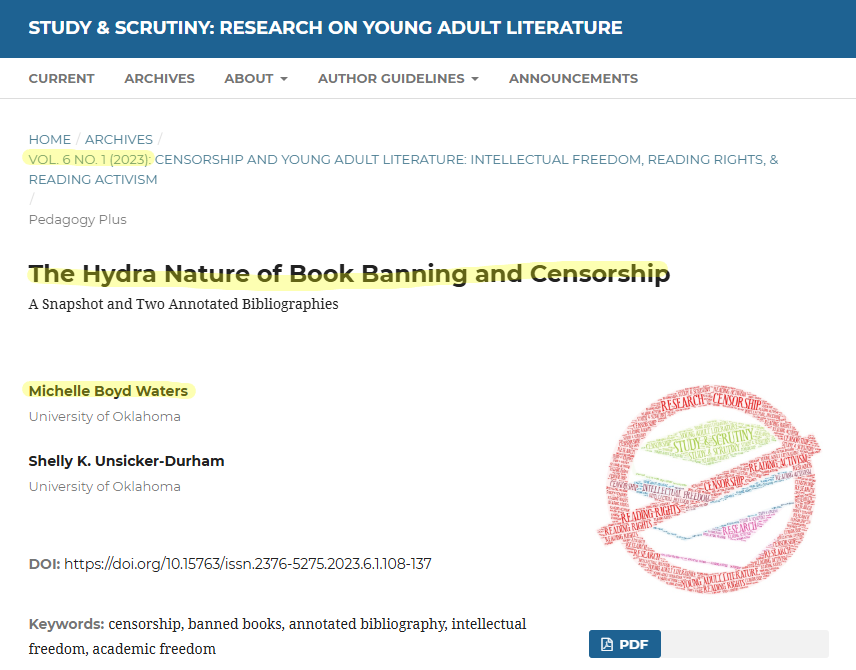
The Tulane Law Review article, "Discriminatory Censorship Laws," focuses on the legal implications of these trends. The authors had mentioned the content analysis my colleagues, Shelly K. Unsicker-Durham and I had worked on through 2022 and published in Study & Scrutiny in 2023. By citing our snapshot of news reports and scholarly trends, the legal scholars were able to use our 'boots-on-the-ground' data to support their legal arguments about how these laws create hostile environments in schools.
When we published "The Hydra Nature of Book Banning and Censorship" in Study & Scrutiny, our goal was to help educators gain a broader understanding of the trends. Knowing that this work is now being used by legal scholars to fight discriminatory laws reinforces why we—as teachers and researchers—must continue to document, collaborate, and share our ingenuity.
All that said, seeing my co-authored research on censorship integrated into an issue of such a prestigious legal journal was a "pinch-me" moment that immediately bridged my worlds of composition, public school teaching, and higher-ed advocacy in a way I had not that was possible when Unsicker-Durham and I were scrolling through journal articles and Twitter posts two years ago.
But beyond the personal excitement of seeing my name in a legal journal, this discovery prompted a much deeper "so what?" for those of us in K20 classrooms. The article that cited our work isn't just an abstract legal theory; it’s a direct examination of the legislative backlash currently targeting inclusive curricula in K–12 and higher education. Seeing our research used to ground a legal argument about "hostile learning environments" and "miseducation" reminded me that the pedagogical choices we make (and the research we produce about them) carry immense weight. When we write about the reality of teaching and the necessity of open inquiry, we aren't just talking to each other in the faculty lounge; we are providing the evidentiary footing for the legal scholars and advocates fighting to protect academic freedom in our schools.
This discovery brings my journey full circle—from my days as a student journalist to ten years in public school classrooms to my current work as an adolescent literacy scholar and director of a university writing center. Whether I was navigating writing for my school newspaper, walking out with my teachers in 1990, the 2014, 2015, and 2018 teacher walkouts, or developing the Curated Short Stories Library for reThink ELA, my goal has always been the same: protecting the curiosity and academic freedom of our students. Seeing our research cited in a venue as influential as the Tulane Law Review validates what we, as ELA teachers, know intuitively: the way we teach students to read, write, and think is a foundational civil right. It’s a reminder that when we advocate for students’ rights to read and diverse mentor texts, we aren't just filling a lesson plan, we are fortifying the very legal and social structures that keep our classrooms places of true inquiry.
Citation:
- Feingold, J., & Weishart, J. (2025), Discriminatory censorship laws, Tulane Law Review, 99, 589-590.
You can read more articles that cite ours here:
- Savitz, R. S., & Howard, C. (2026). Policy and Practice: Navigating the Supports and Barriers to Diverse YA Literature in Schools. Literacy Research and Instruction, 1–24. https://doi.org/10.1080/19388071.2025.2611919
- Boehm, S., & Bean, S. (2024). Dystopian young adult literature as waypoints to censorship across time and space. Changing English, 31(3), 307-319.
Dissertation citations:
This content analysis that Unsicker-Durham and I co-authors has also been cited in a dissertation chaired by T. Hunter Strickland, PhD, who is known for his research in how young adult literature is taught in secondary English teacher education programs.
- McAlister, S. S. (2024). Up for the challenge? A phenomenology of secondary English teachers’ text selection experiences (Order No. 31333000). Available from ProQuest Dissertations & Theses Global. (3097699573).